

Before a candidate ever lands on your careers page, there’s a good chance they’ve already asked ChatGPT, Claude, or Google’s AI overviews what it’s like to work for you.
38% of jobseekers under 30 now use generative AI to research potential employers before they apply. That’s not a future trend, it’s already happening, in the background, every time your organisation comes up in a candidate’s search.
And yet 46% of organisations are doing nothing about it. No one’s checking what the AI says. No one’s shaping it. It’s just… happening to them.
There’s plenty of opportunity within that gap. This is Generative Engine Optimisation, or GEO, and it’s quickly becoming one of the most important employer branding skills few organisations are talking about.
What GEO means
GEO is the practice of structuring your content and public information so that AI platforms can find it, trust it, and use it when they answer a candidate’s question about your organisation.
It’s easy to mistake this for “SEO, but for AI.” It’s more specific than that. Search engines used to send people to your website to form their own opinion. Generative AI tools skip that step. They read your website (and everyone else’s commentary on you), then hand the candidate a ready-made summary. That summary is now, functionally, your employer brand’s first impression.
The uncomfortable part is, you don’t get to proofread it.
Why this matters more for employer branding than most content
Employer brand content has always needed to earn trust, not just get seen. That part hasn’t changed. What’s changed is how trust gets built.
AI-generated answers are built from an amalgamation of structured data, citation patterns, reputation signals, and topical authority; meaning, generative engines lean heavily on what other credible sources say about you, not only what you say about yourself. And candidates already trust those third-party voices more than they used to: peer-sourced platforms like Glassdoor have seen a 24% rise in candidate trust since 2022.
Put plainly: if your employer brand story only lives on your own careers page, it’s the least visible version of your story in the places candidates are now looking.
What actually improves your visibility in AI answers
The research on this is more specific than “publish more content.” Three things consistently move the needle:
- Direct quotes from employees, leaders, or reviews increases visibility in generative AI answers by roughly 28%.
- Concrete statistics instead of vague descriptions increases visibility by around 26%.
- Cited sources increase visibility by close to 25%.
Vague, adjective-heavy content such as “great culture,” “generous benefits,” or “supportive team” gives AI engines nothing to cite. Specific, sourced, quotable content gives them plenty.
This is, not coincidentally, exactly the kind of content transparent employer brands are already best placed to produce. “26 weeks paid parental leave” is GEO-friendly. “Generous parental leave” is not. A named employee’s quote about flexible work is GEO-friendly. A stock photo and a mission statement is not.
Where to start (without turning this into a six-month project)
You don’t need a GEO strategy document before Friday. Three things are worth doing this quarter:
- Ask an AI tool what it says about your organisation as an employer, today, and read it as a candidate would. Look for what’s missing, outdated, or vague.
- Audit your public-facing employer content for specificity. Swap generalities for numbers, named policies, and real quotes wherever you can.
- Build up genuine third-party proof points like verified reviews, credible endorsements, employee stories with names attached, because these are the citation signals AI engines are weighing most heavily.
This is also where a transparent, data-backed model does double duty. Organisations that publish specific, verifiable DEI data and policy detail, the kind WORK180’s Employer Endorsement is built around, are building exactly the structured, citable, third-party-verified content that generative engines are learning to trust and recommend.
The employers who treat this technical hygiene as a real discipline now, while nearly half the market is ignoring it, are getting a strong head start.
The rest will find out what AI has been saying about them eventually, just later, and probably from a candidate who already decided not to apply.
Want to talk through what this means for your organisation?
If this has raised more questions than it’s answered, that’s the point. This is genuinely new territory for most employer brand teams.
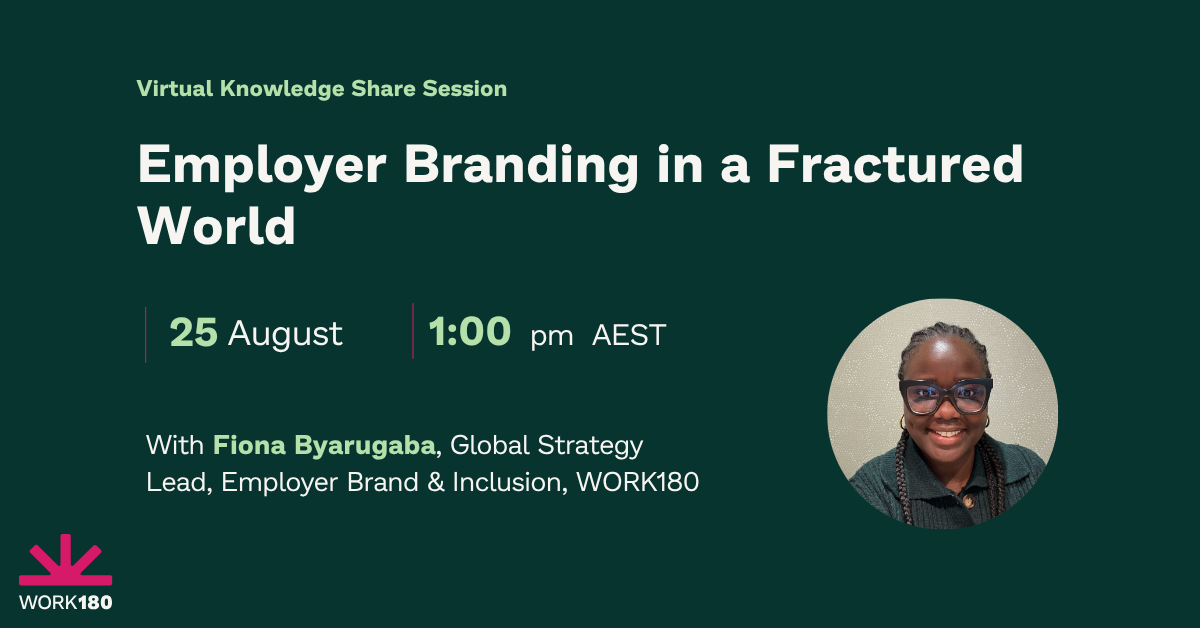
Join Fiona Byarugaba for Employer Branding in a Fractured World, a live Knowledge Share session on:
- Why the trust gap between what employers say and what candidates believe has widened,
- What employees actually want versus what most employers lead with, and
- How to build employer brand content that holds up when someone, or something, goes looking for evidence.
You’ll leave with a practical framework for making your content more credible, and steps you can take in the next 30 days, no rebrand required.

