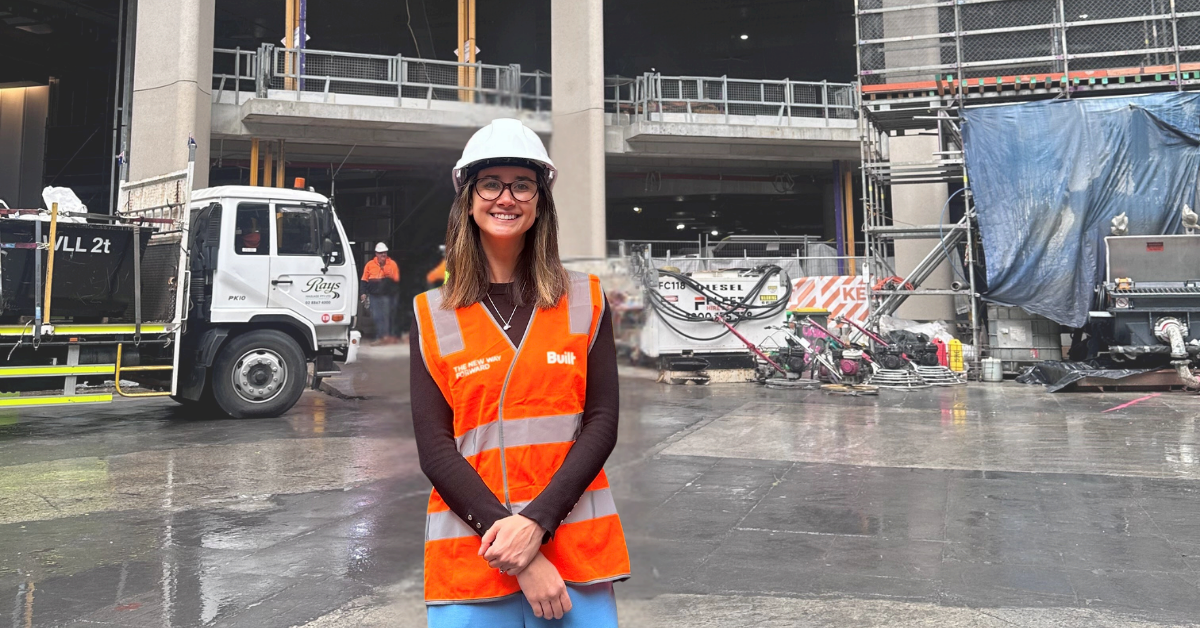
Sylvia Simpson didn’t follow a straight line to get here. Built made sure she didn’t have to.
Summary
- Construction is no longer the “macho” industry it once was, and Sylvia Simpson’s career at Built is proof of that
- Sylvia navigated two rounds of maternity leave, a six-year part-time law degree, and multiple career pivots — all within Built
- Gender equity isn’t about treating women the same as men; it’s about flexibility that bends with your real life
- According to WORK180’s What Women Want 2026 report, 58% of women say workplaces are improving — and Built is evidence of that.
When Sylvia Simpson received her offer to study Construction Project Management at UTS, she burst into tears from disbelief.
What was a girl like me thinking? she remembers asking herself. Had I lost my mind?
– Sylvia Simpson
Today, Sylvia is a Senior Contract Administrator at Built, a mother of two, and a lawyer admitted to the Supreme Court of New South Wales. The girl who cried at her acceptance email turned out to know exactly what she was doing.
Her story is about what becomes possible when an employer has your back.
The industry has changed. The myths haven’t.
WORK180’s What Women Want 2026 report — based on survey responses from more than 1,100 women — found that 58% believe workplaces are improving for women, up five percentage points year on year. But the same report found that 95% of women still face at least one barrier at work, with being judged or underestimated based on gender stereotypes ranking as the number one challenge.
In construction, those stereotypes run deep. When Sylvia started her degree, women made up around 40% of her cohort. By the time she graduated, that figure had fallen to roughly 5%. The industry’s reputation had done its work; keeping women out before they’d even had a chance to begin.
“Women often think of the construction industry as intimidating and ‘macho’ — that you need to be rough and tough. The industry has grown up a lot and is no longer the misogynistic environment it may have been, once upon a time.” She says
Today, Sylvia sees project teams with 30 to 40% women. Not where it needs to be, but heading in the right direction. The shift, she believes, comes down to the industry adapting to meet women where they are — rather than expecting women to adapt to the industry.

The moment she knew she’d found her place
For many women, the real test of a workplace comes at a moment of vulnerability. For Sylvia, that moment was finding out she was pregnant.
“I was on a great path in my career, and I was so nervous to rock the boat.”
– Sylvia Simpson
Her news was met with warmth and excitement. Her concerns were heard. And far from being sidelined, Sylvia found her opportunities expanding. When her second pregnancy followed not long after, Built offered her a work experience placement in their legal department so she could complete her Practical Legal Training before going on leave.
“I had realised, and have seen time and again, that Built are not only accepting of my needs but will offer opportunities for me to grow in my career.”
That’s the difference between an employer who tolerates your life and one who invests in it.

Equity isn’t equality — and that distinction matters
Ask Sylvia what gender equity in construction means to her and she’ll be direct.
“It is a common misconception that women want to be treated the same as their male counterparts,” she says. “The fact is that most women will have different career progressions than men.”
After returning from maternity leave, Sylvia quickly learned that picking up exactly where she’d left off wasn’t realistic. Her priorities had shifted. Her life had changed. A linear career path no longer made sense.
What she needed — and what Built provided — was flexibility. The ability to work close to her children’s daycare. The option to work from home when needed. The chance to pivot into new business, then legal, then back to a site-based role, all within the same company.
“Gender equity in the industry to me meant that my work life could flex with my home life to offer a balanced and sustainable solution. I am treated and rewarded based on merit, and my present needs could be met without jeopardising my future.”
That’s equity; fair treatment, shaped around real circumstances. And according to WORK180’s research, it’s exactly what women are looking for: job security, psychological safety, and respect for work-life boundaries ranked as the top three priorities for women in 2026. Built’s approach to Sylvia’s career delivers on all three.
Her advice to any woman considering the leap
Sylvia doesn’t overcomplicate it.
“100% do it. Be ready to put in the effort. It can be hard but so rewarding — and the rewards are tangible. To be able to watch your efforts literally building up in real time.”
And then there’s the moment she describes with particular pride: driving past a former project, her child calling out from the backseat — “Mummy, there’s your building!!!”
“There’s nothing like it,” she says. And you believe her.