
When Gemma and I started WORK180 from our laptops in 2015, we were drawing on our own experiences of working in tech and manufacturing, but we also knew that was only part of the picture. We wanted to understand what women were dealing with in other industries, in other roles, and at different points in their careers and lives.
So we booked a stall at a careers expo.
We learned a few things very quickly, including how many hidden costs came with an expo stand. For a startup, that was an issue, so we smuggled in our own furniture and got into trouble when the organisers realised. In our defence, the hire fees had “Sydney housing market” energy.
But the biggest takeaway from the expo had nothing to do with the stand aestetics.
Women opened up to us about what they were facing at work and while job hunting. Some were trying to get back into work after having children and finding that flexibility was still treated like some kind of special exception rather than a normal part of working life. Others talked about being overlooked, underestimated, or quietly (and often loudly) channeled into narrower career paths because of assumptions about what they could or should want.
We spoke to women across different industries, roles, life stages and career stages, and many of the same themes kept coming up. I wrote one of my first LinkedIn articles on what we heard. Today, we gather those insights at scale through the What Women Want report, with more than 4,000 women having contributed over time. We also see over 1.5 million women annually using the WORK180 platform to do something they could not do a decade ago: review, compare, and verify what employers actually offer and how they are progressing.
In 2026, more than half of the women surveyed say workplaces are improving for women, which is real progress. Among women working for WORK180 Endorsed Employers, that rises to 71%. But 95% still say they face at least one barrier to succeeding at work and, as always, that progress is not felt evenly. Women facing structural barriers such as racism, ableism and ageism are even more likely to say things are getting worse, and the report specifically notes that findings should be read through an intersectional lens.
What feels especially important to me is where women are noticing progress. Flexible working is the most-mentioned improvement in this year’s report, and over the same period the proportion of women who say they can consistently set boundaries between work and home without worrying about their careers has risen from 16% to 24%. Women also called out better policies and support in areas such as parental leave, carers’ leave and menopause support.
Paid parental leave is a good example of how much this conversation has shifted.
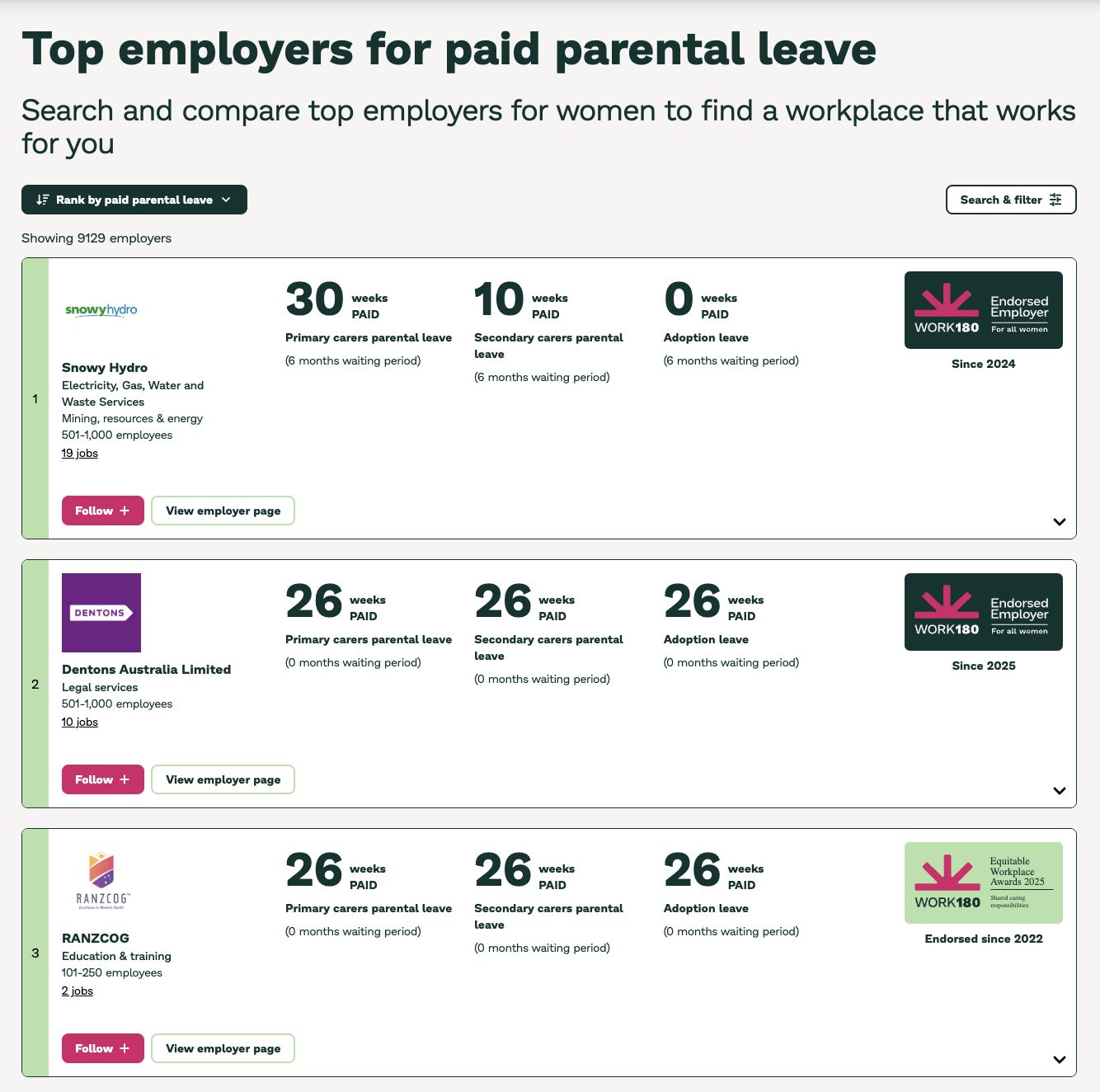
Ten years ago, I am not sure many of us would have expected to see so many employers making that level of support more visible, broadening it beyond old assumptions about who care policies are for, and starting to remove barriers to access. One of the respondents in the report put it well:
“until fathers and non-birthing parents are properly supported too, women will keep being treated as the default caregivers.”
That is exactly why better parental leave matters. It is not just a policy improvement. It changes what workplaces assume about care, ambition and who gets to progress.
At the same time, the report shows how quickly progress can unravel when support exists on paper but not in practice. Flexible work is described as both one of the biggest improvements in recent years and, where it is being rolled back, one of the clearest ways workplaces are worsening for women. Just over one in three respondents say women are being held back by limited access to flexible hours or remote working, and more than half point to the lack of flexible or part-time senior roles.
The report also gives a very clear picture of what women are prioritising now. This year, the highest priorities for women looking for a new employer are job security, psychological safety, and respect for work-life boundaries, with competitive pay and manageable workloads close behind.
None of that means ambition has gone away. In fact, 37% of women say they are looking to level up their careers in the next year. What has changed is that fewer women seem willing to accept the old trade-off, where progression comes at the expense of flexibility, boundaries, wellbeing or fairness. Younger women in particular expect progression, flexibility, inclusion and competitive pay together, not as trade-offs. I loved reading that, because I know majority of women of my generation will agree that 10 years ago, we did not think we had the right to have these expectations.
Still, many barriers women describe are painfully familiar. Lack of transparent information around pay and promotions. Being judged or underestimated because of gender stereotypes. Too few women in leadership or important decision-making roles. These are not signs of women lacking ambition. They are signs of systems still asking women to work around problems they did not create.
It is also why I think it is worth pointing out the difference Endorsed Employers are making, without pretending any employer has this all solved. Women working for WORK180 Endorsed Employers are more likely to say workplaces are improving, and less likely to be looking for a new role. It suggests that when employers take these issues seriously and improve the day-to-day experience of work, women notice.
That is the real thread for me between those conversations a decade ago and this year’s report. Women have been clear for a long time. The real question has never been whether they know what they want. It is whether employers are willing to listen and then do something useful with what they hear.
And that is really the point of this year’s What Women Want report. Not just to highlight where progress is happening, but to make it easier for employers to see where the gaps still are, who is being left behind, and what practical changes will actually make a difference.
If you want to understand what women are asking for now, you can download the What Women Want report.
And if you are serious about turning that insight into action, exploring endorsement is a good place to start.


