

Overview
- Generic, copy-paste applications are the single most common reason resumes and cover letters get overlooked, no matter the industry.
- The strongest applications show your impact and outcomes, not just a list of what you were responsible for.
- A cover letter’s real job is explaining your “why”, not repeating what’s already on your resume.
- What genuinely impresses recruiters is proof you’ve done the work, research, a project, a course, a conversation, not just telling them you’re keen.
Featured in this story







You’ve spent hours getting the wording just right. You’ve read the job ad five times. You hit submit, and then, nothing. If that sounds familiar, you’re not alone, and it’s rarely about you being underqualified. We asked 10 recruiters, the people actually reading these applications every day, what really separates a resume that gets a call back from one that doesn’t. Their answers were more consistent, and more human, than you might expect.
Australia Post: Make it sound like you, AI draft or not
Your content goes here. Edit or remove this text inline or in the module Content settings. You can also style every aspect of this content in the module Design settings and even apply custom CSS to this text in the module Advanced settings.
Peter Halikias, Senior Talent Attraction Business Partner at Australia Post, has noticed a shift lately: more resumes drafted with AI, and more of them sounding exactly the same.
“It’s perfectly fine to use AI to help draft your resume, but make sure it still reflects your personality. Avoid overusing buzzwords, simply replicating the job advertisement, or leaving behind obvious AI-generated formatting and language patterns. Your resume should still sound like you.”
The resumes that actually get his attention lean into storytelling instead of a template.
“Storytelling plays a big part in crafting an effective resume. You’re looking to create a quick connection by using language that resonates with the employer and clearly demonstrates your relevance.”
One recent application showed exactly what that looks like in practice. The candidate opened with a professional summary that highlighted her skills, included relevant data points and referenced diversity programs she’d taken part in, then backed six core competencies with a concise example of her experience, impact or technical expertise for each, before closing with a short list of achievements that made her fit for the role obvious.
“Most importantly, it had personality throughout. It felt authentic, told a compelling story, and made it easy to understand the value she could bring.”

Peter Halikias, Senior Talent Attraction Business Partner at Australia Post
Infosys: Stop writing the resume you think they want to see
Nahla Azmi, AVP, Senior Geo Lead, Talent Acquisition at Infosys, sees the same problem again and again: resumes written for the job ad instead of for the person behind it.
Her fix is refreshingly simple.
“Be yourself! That is the best advice I can give. Do not write the resume you think we want to see. We are not just hiring for skills, we are hiring the person behind those skills.”

Nahla Azmi, AVP, Senior Geo Lead, Talent Acquisition at Infosys
Powercor: Show us, don’t just tell us
Alex Vrabac, HR and Early Careers Advisor at Powercor, has read plenty of resumes dressed up in corporate language, and says it almost always backfires.
His tip: swap responsibilities for results. Highlight what you actually achieved, improving a process, leading a project, solving a persistent problem, and be specific about the outcome, rather than listing what was on your job description.
The application that has stayed with him longest wasn’t even for a job. It was for Powercor’s Women’s Pre-Apprenticeship Scholarship, from a candidate who had already enrolled in training and relocated to attend it before she’d applied.
“The biggest takeaway for candidates is that showing recruiters the steps you’ve already taken towards your goal can be far more powerful than simply telling them how much you want the opportunity.”

Image supplied by Powercor
Queensland Airports: Write a cover letter that shows you did your homework
Queensland Airports’ People and Culture team reviews a lot of applications that feel like they could have been sent to any employer. The strongest ones do the opposite.
Their tip comes down to research, and sometimes it’s the smallest detail that proves it
“Addressing a cover letter to the hiring manager rather than using a generic ‘Dear Hiring Manager’ shows initiative, attention to detail and genuine interest in the opportunity.”
One applicant for a marketing role took that further, using the design and layout of their own application to prove the graphic design skills the role required, rather than just listing them.
“Rather than simply telling us they had strong design capabilities, they used the application as an opportunity to showcase them.”

Queensland Airports’ People and Culture team
Hydro Tasmania: Pay attention to the small details, and let your cover letter show who you are
Chelsea Wolfert, Talent and Experience Partner at Hydro Tasmania Group, says most applications aren’t let down by a lack of experience, they’re let down by carelessness.
Her tip for the cover letter itself is to use it to say what your resume can’t.
“Your cover letter is your story. Your resume tells us what you’ve done, while your cover letter helps us understand who you are, what motivates you, and why you’re interested in the role and our organisation.”
The best example of that Chelsea has seen came from a woman moving out of disability support work and into a trade, who backed up her cover letter with a video resume.
“In it, she showcased the refurbishment of an old campervan, including the installation of a solar power system, and shared her experiences camping at our recreation sites.”

Image supplied by Hydro Tasmania Group
Sportsbet: Applying above your level? Use the cover letter to own it
Michelle Magness, Talent Acquisition Partner at Sportsbet, sees a lot of people apply for roles that are simply out of reach for where they’re at right now.
If you are stretching for a role, her tip is to use the cover letter to own it.
“It does help me see if someone isn’t quite at the level they’ve applied to, how they will bridge the gap, and what skills they feel they have that will help bring them up to speed and shorten the learning runway.”
What impresses her most isn’t one standout resume so much as a pattern she keeps seeing.
“The ones that stand out the most are the applications that come across as really wanting to join the company, they’ve done their research and it’s more than just a job.”

Sportsbet’s Talent Acquisition Team
TasNetworks: Get the basics right first
Sara Kean, Leader Talent and Early Careers at TasNetworks, keeps her advice practical: get the fundamentals right before you worry about anything else.
The mistake she sees most often is incorrect information about the role and the company, including incorrect documents uploaded or not providing the information requested.
Her tip is just as straightforward: keep your resume clear and concise, use a recommended template, and have someone proofread it before you send it. A cover letter matters here too, not as a formality, but as proof you’ve actually looked into the company.

Sara Kean, Leader Talent and Early Careers at TasNetworks
Thales: Your side projects are doing more work than you think
Vera Goga, Talent Acquisition Business Partner at Thales, says candidates constantly undersell the work they’ve done outside a formal job title.
“Undervaluing projects and practical experiences is also a common and significant missed opportunity in job applications. Detailing projects and outcomes showcases real problem-solving skills, initiative, leadership, and tangible impact.”
Her tip is to open strong and keep building from there.
“Think of your resume as a story about your professional journey. Use it to show how you’ve grown, overcome challenges, and developed your expertise over time.”
The applications that go furthest with her tend to share something in common, real, ongoing investment in the field, whether that’s volunteering, workshops, community events, mentorship, or a personal project.
“These applications stand out because they help tell your story of dedication, lifelong learning, and community involvement, providing a much richer context when learning more about you.”

Vera Goga, Talent Acquisition Business Partner at Thales
Toyota Australia: Skip the profile photo, answer the extra questions
Toyota Australia’s Talent Acquisition team says most of the CVs that miss the mark aren’t missing experience, they’re missing basic structure.
“Oftentimes the biggest ‘mistake’ I see in CVs and applications are relatively minor structure or aesthetic errors. For example, CVs can be written in various different fonts, poor formatting, poor layout or with far too much information.”
Their tip: keep it simple, back your points with real evidence, skip the profile photo (it can work against you through unconscious bias, and it isn’t necessary), and don’t skip the extra questions on the application form.
“Candidates who take time to fill out the screening questions when they submit their application display a stronger level of engagement for the role overall.”
The applications that go on to succeed usually have one thing in common: real engagement with the actual job ad and the company behind it.
“Profiles from candidates who have taken the time to really digest the job advertisement and done adequate research into the company of interest stand out the most.”
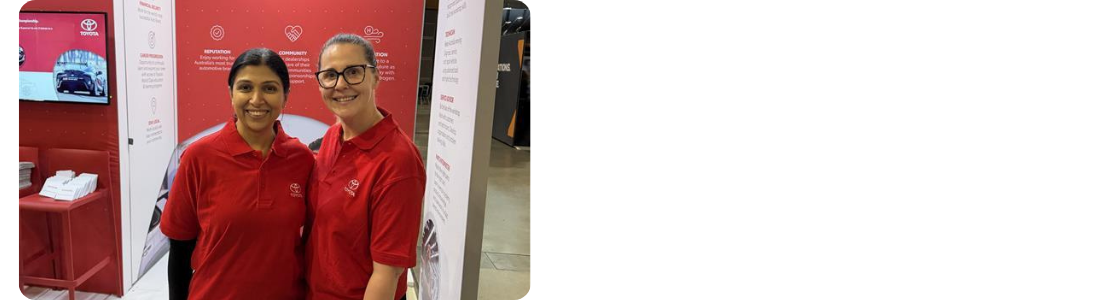
Toyota Australia’s Talent Acquisition team
Urban Utilities: Polish your CV, but keep it human
Boyd Clifford, Talent Acquisition Lead at Urban Utilities, has watched AI change how a lot of applications sound, and not always for the better.
“With the increased use of AI, there has been a noticeable shift in the way some CVs and applications are written. They can be polished, but sometimes lose the person behind them.”
His tip is reassuringly simple: personality still counts, and at Urban Utilities, a human is always the one reading.
“AI can be a helpful tool, but it should support your story rather than replace your voice. At Urban Utilities, we do not use AI to screen applications. Applications are reviewed by people, so relevance, clarity and personalisation still matter.”
One candidate who stood out to him had applied for three different roles over time, and used what they’d learned from each attempt to strengthen the next.
“What impressed me was their persistence, but also the thoughtfulness behind the application. It felt authentic, purposeful and showed genuine interest in the organisation rather than simply applying for another job.”

Image supplied by Urban Utilities
So, what actually gets you noticed?
None of these ten recruiters are describing a trick. Nobody here is talking about keyword-stuffing your resume or gaming an application system. What comes through, again and again, is: research the role, tell your own story in your own words, back it up with something you’ve actually done, and get the basic details right. Standing out is about making it easy, and quick, for someone to see who you are and why you’d be good at this.
Explore all ten employers on WORK180, and find the one that’s actually looking for someone like you.
